


tfb or NE1 else


Senior Member
Joined: Dec 2012
Posts: 705
From: UK

Passed the MOT with the usual advisories for a cracked wing mirror and barely sufficient handbrake - which have been advisories for the last 4 years!
I'll try and find the install disk for PAIS and the instructions on how to install it as it's a bit of a bugger from what I remember.
Agreed, when pushing the pistons back in it's best to slacken off the bleed valve and let the pressure be released that way
Regards
Richard
I'll try and find the install disk for PAIS and the instructions on how to install it as it's a bit of a bugger from what I remember.
Agreed, when pushing the pistons back in it's best to slacken off the bleed valve and let the pressure be released that way
Regards
Richard
Thread Starter
|
Senior Member
Joined: Jan 2012
Posts: 1,611
From: UK
Passed the MOT with the usual advisories for a cracked wing mirror and barely sufficient handbrake - which have been advisories for the last 4 years!
I'll try and find the install disk for PAIS and the instructions on how to install it as it's a bit of a bugger from what I remember.
Agreed, when pushing the pistons back in it's best to slacken off the bleed valve and let the pressure be released that way
Regards
Richard
I'll try and find the install disk for PAIS and the instructions on how to install it as it's a bit of a bugger from what I remember.
Agreed, when pushing the pistons back in it's best to slacken off the bleed valve and let the pressure be released that way
Regards
Richard
Last edited by QinteQ; May 29, 2015 at 08:48 AM. Reason: put in version number for tfb
Thread Starter
|
Senior Member
Joined: Jan 2012
Posts: 1,611
From: UK
I was hoping someone would argue with me about how the disk caliper piston pressure is released when you take your foot off the footbrake. A rewind of knowledge would be appreciated. I would like to begin again at zero-knowledge point and reconsider exactly how the pistons on an ABS system have just enough pressure taken off them by what component.

Senior Member
Joined: Nov 2012
Posts: 1,782
From: Dumfries....
Master cylinder via your foot supplies the pressure to caliper piston. When foot is released so is pressure in line to caliper piston. But why doesn't piston which is on back of pad make pad continue to rub disc.
Some run out of disc pushes piston back but it is dependent on shape of piston seal inside the caliper.
If the caliper piston seal was an "O" ring piston would not retract at all, good seal though.
Look to the square shape of the caliper seal. Pressure applies, piston moves, but square seal sort of coggles against piston. Release pressure and seal prises piston back. Little movement it coggles. big movement piston slides over seal. vis versa.
Like this beer slipping over my lips.
Hope this helps, its better to see it in pictures thou.
Some run out of disc pushes piston back but it is dependent on shape of piston seal inside the caliper.
If the caliper piston seal was an "O" ring piston would not retract at all, good seal though.
Look to the square shape of the caliper seal. Pressure applies, piston moves, but square seal sort of coggles against piston. Release pressure and seal prises piston back. Little movement it coggles. big movement piston slides over seal. vis versa.
Like this beer slipping over my lips.
Hope this helps, its better to see it in pictures thou.
Thread Starter
|
Senior Member
Joined: Jan 2012
Posts: 1,611
From: UK
HiYa goggsy, I agree its rotary inertia that pushes the cylinder off the pad when the master releases the pressure, I just want a re-learn on the whole ABS braking theory but can't find any handy docs to read. There's a mater cylinder then the hydraulic control unit [HCU Pump] then the controller anti brake [CAB] which is the bit [section 3.1 TEVES MARK 20e SYSTEM DESCRIPTION in the workshop manual] that's supposed to 'modulate hydraulic pressure to prevent wheel lock-up during braking' then also in an ABS with Teves the Electronic Variable Brake Proportioning (EVPB) to balance front-to-rear braking when brakes are applied in the partial braking range.
I'm not over reading it - its all there in the chassis section of the Daimler Chrysler own issue workshop manual. Then today I've developed a 3 3/4 inch vertical black line the whole height of my 60 inch TV. I fixed the last one with two 14 penny Microfarad Capacitors from Maplins I wonder if I can do a Lazarus with this set. Maybe I should just fix the brakes first and learn how they work later and concentrate on repairing my telly.
I'm not over reading it - its all there in the chassis section of the Daimler Chrysler own issue workshop manual. Then today I've developed a 3 3/4 inch vertical black line the whole height of my 60 inch TV. I fixed the last one with two 14 penny Microfarad Capacitors from Maplins I wonder if I can do a Lazarus with this set. Maybe I should just fix the brakes first and learn how they work later and concentrate on repairing my telly.
Senior Member
Joined: Dec 2012
Posts: 705
From: UK
http://1drv.ms/1KuBaxT
Chrysler PAIS III loaded onto a VMware virtual machine....a real bugger with .net and java problems before I could get it running. You will have to set the date on the Virtual Machine to pre 2012 though
Regards
Richard
Chrysler PAIS III loaded onto a VMware virtual machine....a real bugger with .net and java problems before I could get it running. You will have to set the date on the Virtual Machine to pre 2012 though
Regards
Richard
Thread Starter
|
Senior Member
Joined: Jan 2012
Posts: 1,611
From: UK
http://1drv.ms/1KuBaxT
Chrysler PAIS III loaded onto a VMware virtual machine....a real bugger with .net and java problems before I could get it running. You will have to set the date on the Virtual Machine to pre 2012 though
Regards
Richard
Chrysler PAIS III loaded onto a VMware virtual machine....a real bugger with .net and java problems before I could get it running. You will have to set the date on the Virtual Machine to pre 2012 though
Regards
Richard
- even harder now with mobiles and the drive for cross platform Win to mobile etc integration
- for more than a decade I've created a separate clean O/S install to a working surplus HDD on its own BIOS switched cable
- that way my own 'work~a~day Win 9 O/S never gets compromised and a simple reboot means its 'stand alone'
- it only fails when you lend it to a Muppet who can't follow simple BIOS booting instructions .......................... grrrrrrr
the usual advisories for a cracked wing mirror and barely sufficient handbrake
- my 'spotted' front disks have been there for 3 years, and might still be there in 10 years, I only so 2kpa, they are bound to have rust spots
- don't let it worry you mate they have to do it or they get - - checked on !
Thanks Rich !
Thread Starter
|
Senior Member
Joined: Jan 2012
Posts: 1,611
From: UK
In #1 of this thread I said """I suspect those pistons have been in a stuck all the way out position for many many years"" and in #3 I said """I am embarrassed at what I found but what I did find suggests that unless we are prepared to do an apparently unnecessary complete strip of the whole calliper each GV owner might be blithely running around with seriously compromised brakes""" Here are the rear's then front's of my rear disk pads so we can all learn from my mistake.
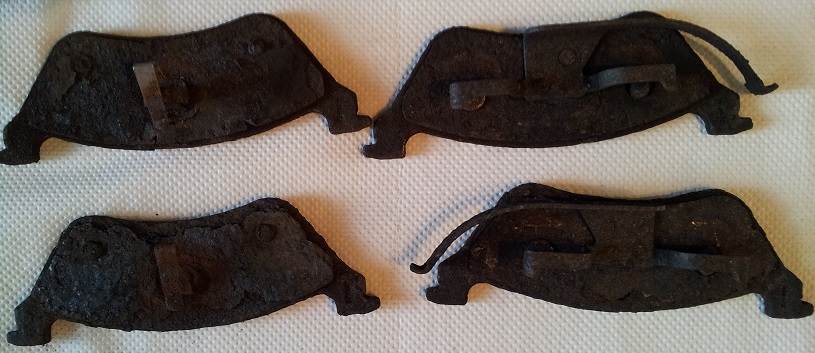
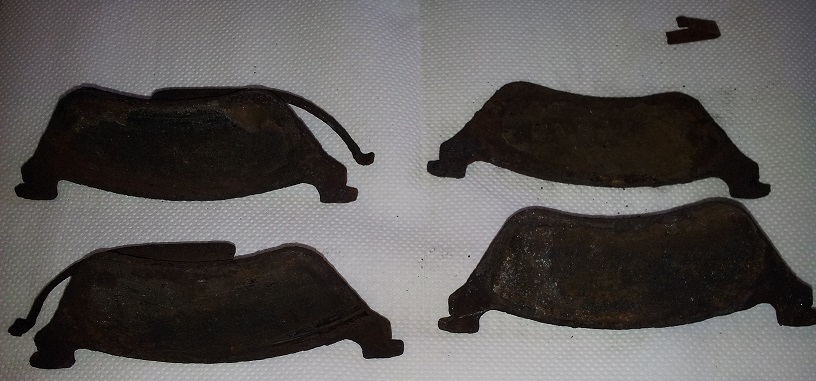
The pistons worked well enough to pass the VOSA test and retracted just enough microns not to bind. When after unreasonable force was used to put the pistons back in enough to fit new pads the piston always locked on like the taxman's death grip and would not release under any circumstances. Clearly the pistons were semi-seized on and had been for years and ditto the metal on the footwear was old and thin enough to have been eaten through by years of neglect and the pad material was lace thin where any existed at all..
NOTE : The broken cornet clip from the one of the inners on the TRHS, it was so thin it sheared off when I just lightly touched it.
A lesson to me [per Leedsmans comments a few months ago] check em yourself, rely on no one, 15 minutes a corner and strip the calliper completely - only when you turn it upside down and eyeball it yourself can you truly say .............. I've checked ................ they're ok ................ put the grand-kids in luv !
The pistons worked well enough to pass the VOSA test and retracted just enough microns not to bind. When after unreasonable force was used to put the pistons back in enough to fit new pads the piston always locked on like the taxman's death grip and would not release under any circumstances. Clearly the pistons were semi-seized on and had been for years and ditto the metal on the footwear was old and thin enough to have been eaten through by years of neglect and the pad material was lace thin where any existed at all..
NOTE : The broken cornet clip from the one of the inners on the TRHS, it was so thin it sheared off when I just lightly touched it.
A lesson to me [per Leedsmans comments a few months ago] check em yourself, rely on no one, 15 minutes a corner and strip the calliper completely - only when you turn it upside down and eyeball it yourself can you truly say .............. I've checked ................ they're ok ................ put the grand-kids in luv !


Thread Starter
|
Senior Member
Joined: Jan 2012
Posts: 1,611
From: UK
Agreed Al, I will confess to being more than embarrassed, I'm light~of~foot and I can only assume that the previous owner [deliveries & collections of antiques] had an equally insubstantial braking foot style to have had the metal rot over enough salt winters. So many in fact that the glazed friction material nearly outlasted the metal. I just thought I'd overcome my shame and post it as a warning [aka Leedsmans handbrake] to the group.

